Sunday, September 27, 2015

Self-Discovery: there is a test for that!

George W. Bush.  Paul the ApostleBoromir.  Dana Scully.  What do they all have in common?  Supposedly they are all Myers-Briggs ESTJ (Extravert, Sensing, Thinking, Judging) personality
types: strong willed, organizers, guardians, creators of order, and reliable.  How they got Boromir or Scully to take the test is beyond me.  ESTJs are also apparently stubborn, judgmental, struggle with unconventional solutions, and have difficulty relaxing.  I am an ESTJ personality type though I am a borderline Intravert/Extravert.  I'll admit to most of the above (except I am also lovable).

I have been assessed and tested lots over the years as various tools rolled through my workplaces.  Sometimes useful for understanding workplace dynamics, others examined my teaching, learning, or leadership styles.

Another sort of assessment explores your gifts and strengths.  I have used assessments like these in churches to help people explore volunteer opportunities.  These assessments tend to be of two types: spiritual gifts or natural talents.  The first looks at the talents and gifts described in the Bible.  The New Testament Letter to the Romans, for example, lists seven gifts/talents to serve the church: prophesying, serving, teaching, encouraging, giving, leading, and showing mercy.
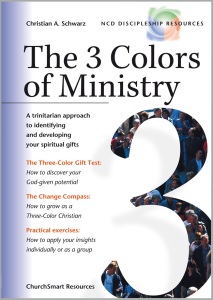
3 Colors of Ministry One of these skill tests was The 3 Colors of Ministry that uses 180 questions to rank 34 different gifts/talents.  When I took that test my strengths were: teaching, wisdom (!), missions, discernment, and pastoring. The tests provided definitions and descriptions of each of these gifts, as well as blind spots and tips for developing the gifts.  Teachers in the church could lead a small group Bible study (as I do) or teach classes and seminars. Teacher types are warned that they must be careful to live what they teach, take the time to prepare effectively, and continue to be a learner.
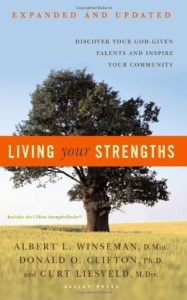
Living your strengthsThe other type of test considers natural talents and abilities discovered through extensive surveys and testing.  These aren't particularly religious but can be applied to a religious context like a church.

Living Your Strengths by Winseman and Clifton is one of these. Built on the Gallup Clifton Strengths Finder research, these tests are used in companies to build work teams. The test is built on the premise that we are often too focused on our weaknesses when we should be building on our strengths.  I ran across this test in a local church that uses it to help people find where they can serve best in their church.

I took the test and discovered my strengths were, in order: (drum roll...) Analytical, Input, Learner, Belief, and Responsibility.  Different categories from the 3 Colors test but with conceptual overlap. In a nutshell (!), I question and investigate because I need to know, I collect information, and I love to learn.  Winseman and Clifton suggest that people with these strengths don't like contradictions, or "wishful" or "clumsy thinking." However if not careful can be harsh in their critique.  They can collect far too much information.  They have a belief system that includes strong ethics, and a need to take personal responsibility ("my good name depends on it.") Their work must mesh with their values and must be meaningful.  Oh, and they probably over commit. Boy, that does sound a lot like me. Kind of creepy when these tests are accurate.

There are lots of tests out there; some better than others.  Though these are useful to develop self-understanding, I've often found the best test to determine your strengths and weaknesses is a group of wise friends who know you well enough to tell you what they see, and to whom you will listen. Churches, when they work well, are good places for that.

Friday, May 15, 2015

Info Tech Goes to Church (and Something Changes)


Churches have had a long history of adopting new media to communicate their message whether it was plays, the printing press, or contemporary film.  New technology offers resources that impact preaching by integrating multimedia in worship, expanding outreach through streaming services and podcasts, and providing live feedback through tools such as Twitter/chat.  The life of religious communities is also impacted by new communication technologies that blur the boundaries of local and remote participation and challenge traditional ideas of koinonia (fellowship).

This year's annual conference at the Center for the Study of Information and Religion at Kent State University (June 5, 2015) will explore the impact of new tech on religious organizations.  I will be speaking about the potential legal, ethical, and theological implications of the tech we bring into the church.  Join our conversation; this is a whole new world to explore!


Friday, May 8, 2015

Roaming bands of Librarians invade Moncton...

Doesn't strike terror in the heart does it? There really was a band but it was a ukulele jam.  For five days the Canadian Association of Law Librarians met in warm and sunny (!!!) Moncton, NB for their annual conference.  You can get a flavour of the conference by following the tweet stream from the conference. Great to see old friends and make new ones, and we will all remember the closing reception at Parlee beach when the power went out!

I wanted to share a few of my favourite moments from the conference:

Fred Headon, Chair of the CBA’s Legal Futures Initiative, was our first keynote and raised questions about the direction of the legal profession.  He drew on his experience as In-House Counsel with Air Canada (we learned lots about pilots and airline processes, and a few things about dentists) to ask how the profession can innovate to place the client at the centre of service delivery.  Relevant question for librarians as I often feel our innovations still have us at the centre. Favourite Quotes (via @conniecrosby): "Law today looks a lot like his grandfather's law practice in Moosejaw - unlike other industries that have changed", (via @smireau) "There is not much sacred about how we do our jobs."

Jen Adams and Jon Shapiro (and Mark Lewis in spirit) deserve mention for their presentation on using online student engagement platforms in the classrooms to transform mundane content to an interactive experience.  They demonstrated that the tech use was rooted in their pedagogy and more than a cool trend.  The use of technologies like this in their flipped classroom experiment is cutting edge and it is important we share these innovations. Favourite quote: "Just ask my students, I'm like this all the time."

Annette Demers breakout session on "Beyond Bureaucracy: Building a User Centred Library from the Ground Up" was inspired by her own frustrating library experiences.  Indignation is usually the root of revolution.  She spoke about transforming services from top down bureaucracies to client centred where we ask "how can we make this happen?" I loved her enthusiasm and passion! Favourite quotes: "we are soft-shelled organisms on a ball of burning rock hurtling through space. Change is likely," "My job as a leader is to resource you," and "bureaucracy, patriarchy and micromanagement stifle employee engagement and initiative."

Surprisingly, Law Prof. Wayne MacKay's presentation "Effectively Responding to Cyberbullying: There's No App for That" struck a nerve for me.  I say surprisingly, as Wayne and I work in the same faculty and I have heard his presentation before.  He questions how it is that someone could bully another in this way so cruelly "just for fun."  I think we have created digital "Lords of the Flies" islands where immature people are left to govern themselves and then we are surprised by the results.  There were lots of solutions suggested like restricting access to the Internet and better parental tech training, but it struck me that with the speed technology changes we will never be ahead of the curve.  I wondered if we need to be teaching ethics rather than tech to parents, teachers, and students.  Here is where my personal beliefs are reflected: in our increasingly ego-centric and self-gratifying world, we all need to be reminded that we are each made in the image of God, by virtue of that, each of infinite value, and how we treat those around us will have eternal consequences for good and for evil.

Lots more sessions, and I can't describe them all. It was a good conference, I learned a lot, and they fed me well (far, far too well).

Photo Credit: JoshJRobbins, P1010511 https://www.flickr.com/photos/35699781@N07/6073292857/ cc licence.

Creative Commons License
This work is licensed under a Creative Commons Attribution-NonCommercial 4.0 International License.

Tuesday, March 10, 2015

Oh to be the library's Alvin Toffler!

What is the future of library reference services? 

On March 5, 2015 I had the privilege to speak on that topic with the students of the Nova Scotia Community College Library Technician program.  I've taught students in the Master of Library and Information Science program, but this is the first time speaking with this group.  They are a wonderful group of students, and they are keen to understand where their profession is heading.  The invitation came as a response to my request on the APLA listserv for innovative research support service examples.  I was curious what cool things were going on and so were these students.

It was surprised by how few innovations were forthcoming.  If libraries are transforming themselves why are the changes so modest and...well frankly uninspiring?

I shared three examples of significant innovations that got my attention, both high and low tech:

1. University of Melbourne Law Research Service and Legal Academic Skills Center.
The first service provides dedicated research staff to support faculty research.  The second is a confluence of services designed to build student research skills including classes, workshops, and student wellness programs.  (Yes, we do most of these things already but what we don't do is integrate them with dedicated staff at this level of commitment.)

2. Simon Fraser University, Research Commons.  Going the next step, SFU has used the idea of the research lifecycle to guide their integration of services to students and faculty.  From creating the spaces and opportunities for idea creation, fostering collaborative partnerships, developing proposals and grants, facilitating research (traditional library stuff), to the publishing role (an emerging library role.)  One place to support the whole research endeavour.

3. Hold onto your seats: The Hunt Library, University of North Carolina.  This is a showcase of technological and social experimentation for libraries.  With immersive labs, and new private, semi-private, and collaborative work spaces, this library is breathing new life into the library as third space. (Watch the video.)

Three different focuses, three innovative visions of the role of the library as the locus of research.  The students and I discussed the implications of implementing these ideas, and the small steps we had taken to implement pieces into our own practice.  In the face of gloomy prophecies of the death of libraries, there are rays of hope for the next generation of information workers.

I wish I could see into the future.  A lot of the speculative fiction out there doesn't paint a very encouraging image of the future reference librarian.  I think of the holographic librarian interface from the 2002 remake of the Time Machine.  Reference is reduced to merely an interactive AI interface to the database of knowledge.  I think there are possibilities out there for really interesting services that are more than a better digital interface.  To borrow a quote from the futurist Alvin Toffler, "Society needs all kinds of skills that are not just cognitive; they’re emotional, they’re affectional. You can’t run the society on data and computers alone." 

Thanks for the invitation, NSCC! I hope you enjoyed our time as much as I did.

Saturday, February 21, 2015

Why don't you read my research?


Why don't you read my research?  My blog tagline is "Informing faith so faith can inform life."  I,like most researchers, hope that my research has an impact: it informs, illuminates, and changes my communities in a positive way.  I want my research to help churches and not-for-profits impact their own communities.  Universities and governments are also interested in researchers' impact.  Institutional reputation, grant funding, and knowledge mobilization are on their minds. 

There is a lot more research out there.  Maybe too much.  There are more PhDs.  The pressure to publish, and publish is more highly ranked journals, is increasing.  There are more journals in traditional and new online formats.  How can I get my research to stand out?
I have reflected on this as an information scientist.  We know how people seek information so why can't we reverse engineer how to make it more "findable" (is that a word?)  Librarians have largely limited their new role to collecting and preserving research through digital repositories.  Although important, this is in many respects still old school collecting.  We have traded brick boxes for digital boxes.  A more exciting role is the championing of Open Access publishing.  This year we will convert our second Law school journal to an online open format.  Where else can we contribute?  As universities focus more on measuring research impact, I am reminded that information scientists like bibliometrician Blaise Cronin have been studying how research was accessed and cited for decades.  This should be familiar territory for us.  I think we need more Blaise Cronins. I think I'll give him a call. :-)

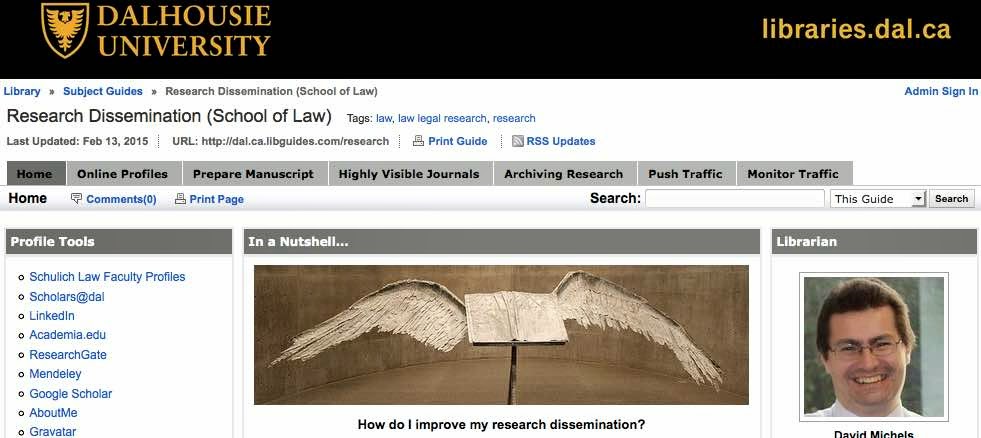
Serving on my faculty's Research Committee has impressed upon me how the question of research dissemination weighs on many minds.  What new skills do researchers have to learn?  What skills might librarians contribute?  This is worth exploring together.  In the meantime with support of my faculty colleagues I have developed a tool to support research dissemination.  What do you think? Are we on the right track?

http://dal.ca.libguides.com/research


Image Credit: Creative Commons License - "impact / impakt / n." by Nick Southall, June 28, 2011, on Flickr .

Sunday, January 4, 2015

The Netflix Phenomenon Goes to Church

This past summer we finally cut the cable.  With AppleTV and subscriptions to iTunes and Netflix we rarely miss those 150 channels of "Friends" reruns.  Of course the limitation with any streaming service is that someone else sets the menu.  It is a wide menu so there is always something to watch. But where is Babylon 5?  And when do we get the next season of Murdoch Mysteries?


My church recently signed up for a Netflix-like  subscription streaming video service: RightNow Media.  This service offers libraries of video Bible studies, leadership training materials, and christian conference presentations.  There are hundreds of video studies for adults on Bible, Marriage, Parenting, Finances, Evangelism, etc.  There are stories for children from series such as Veggie Tales (now coincidentally produced by Netflix). 


Evangelical teachers like Francis Chan, Bill Hybels, or Andy Stanley can join your Sunday school class or home group meeting for a low monthly fee.  All members are provided individual passwords to log into the website and app.  The church has the ability to create packages of teaching materials or publish a church favourites list.  The small group I attend is using Francis Chan's study Crazy Love.  We watch the video lesson and then discuss the questions from the accompanying study guide.  It challenges the unexamined faith. (You can watch Chapter 1: "Stop Praying" below.)

Previously Sunday school teachers and study leaders would trundle down to the local Christian bookstore to purchase appropriate materials.  When studies on video tape became available they were expensive and churches would buy one VHS or DVD set that might circulate among groups.  This model brings educational and inspirational materials to the living rooms and mobile devices of individual members.  For church leaders it offers exciting possibilities.

It does raise for me other considerations about the Theology of Information Seeking.  RightNow Media is a not-for-profit ministry based in the U.S.  There stated mission is "to help people trade in the pursuit of the American Dream for a world that desperately needs Christ."  Their goal is "to encourage millions of Christians to be on mission wherever God has them ... to be TRADERS... people who intentionally put “others before self, and Christ above all.”  Theologically the ministry's doctrinal statement is conservative, evangelical, and premillenial.  The videos they include however represent a wider cross-section of the evangelical spectrum and many would be of interest outside the evangelical fold.  For instance it was a Catholic Seminarian who first introduced me to Chan's Crazy Love.  This kind of church sanctioned service however does shift the locus of teaching doctrine from the local church pastor to an external source.  Are we prepared to outsource this responsibility?  It merits thought; the New Testament standard for religious educators is very high.  Personally I think the potential for a resource like this outweighs the potential problems.  Nonetheless, this changes things and warrants further consideration.  I think this is my next research project.

Enjoy Francis Chan's Crazy Love, 2nd ed. (Colorado Springs, CO: David C. Cook, 2013), Chapter 1: "Stop Praying"


Thursday, December 18, 2014

A Grand Vision: The Halifax Central Library

Today I visited the new Halifax Central Library.  Wow.  I only had a few minutes before my bus to rush in to look around.  I am impressed.
It is a grand building undoubtedly, and beautiful.  What also struck me was that it is a people place.  People reading, chatting, studying, meeting, and, like me, gawking.  I remember some years ago attending a conference session of community spaces.  A European graduate student described her puzzlement when she first arrived in Halifax.  She wanted to find the 'piazza', the city plaza common in many European cities.  "Where do people meet here?" It was an interesting question. "At the mall maybe. or a local bar" we offered.  Once upon a time the community church was the meeting place in North American communities but regrettably few still play that role.  After all these years I think I have an answer to her question. For at least the folks on the peninsula the Halifax Central Library has the potential to be our piazza. 

I was struck with the many kinds of spaces in the library.  The Halifax Living Room of the top floor offered a spectacular view of the city but was also a quiet reading spaces.  A couple chatted on one sofa while another person curled up in a chair with a book.  It did have a living room feel.  Students clustered in alcoves and lone researchers worked away on laptops in semiprivate alcoves.  The coffee shops were alive with conversation.  And people checked out books; lots of them.  That is note worthy in such a high tech facility.

Some people will disagree with the design and style of the building.  Others might chaff at the cost of such a space.  I can see those concerns.  I'm not usually a fan of monumental construction myself.  I usually find an atrium a colossal waste of space (and I really hate skywalks).  The openness of this space however adds to its appeal as a community place.  I also admire the grandeur of the vision, something that Nova Scotia needs more of.  It is more than the architectural feat.  It is community building.  It is something as a city we can be proud of.  It is creating buzz. In a dying province we need that kind of thinking.

As I left the stood out front of the library waiting for my bus I came to a realization.  I am tired of little visions.  I want more grand visions; not just the same old tired ideas writ bigger.  I want to be part of transforming visions.  It needn't be buildings, but it needs to be outlandish.  Thanks Judith Hare and your team for being doggedly persistent.


Enjoy the brief tour from CBC. But trust me, you'll want to check it out yourself.

"Halifax Central Library", http://www.halifaxcentrallibrary.ca/
"Piazza Navona", Giorgos, May 7, 2007, Flickr: https://www.flickr.com/photos/vintzileos/

Sunday, November 9, 2014

Defining Leadership Inside and Outside the Church

My church is looking for a new Lead Pastor.  Last week (October 27, 2014) I attended an information meeting to learn about the process.  In Baptist circles pastors are hired by the local congregation (though often with denominational assistance).  As the job ad suggests there are biblical requirements, character qualities, educational achievements, and professional skills required by candidates for this office.  It is a difficult calling.  Coincidentally my faculty is looking for a new Dean. This week I had a visit from a search committee member soliciting my perspective about what we needed in a Dean.  Most faculties will expect that a Dean will be an effective manager, an academic, and the public face of the school.

I have been reflecting on leadership and what makes someone a leader both in the church and outside.  I'm going to distinguish between people in leadership roles and leaders. Not every administrator is a leader.  Leadership is however a tricky concept to nail down.  If you executed a library catalogue keyword search for the term leadership you would find nearly half a million books.  A leader, at its simplest level, is someone others choose to follow.  For the church Jesus would be the archetypical leader: he founded Christianity but never studied theology, never held office, never had an earthly title, or even owned a piece of property.  People followed him to their death (and beyond).

Ok, maybe not fair to invoke Jesus Christ here so lets consider a human example: Ghandi.  He has been called "the preeminent leader of the Indian independence movement" but his leadership was not based on political office or traditional power.  In part it was his personal charisma.  Obama's charisma (he was relate-able) helped get him elected.  Pope Francis' charisma (he is inspiring) will help him introduce tough reforms.  But charisma is fleeting, and leadership must be built on something deeper.

So I thought what makes me want to follow someone?  Here is my list:

1. TRUST.  I trust a leader who cares for my interests as well as their own and values the things I value.  We live in an age where a CEO can lay off 1000 employees and take home a million dollar bonus.  Then the company brings in a consultant to help build trust and morale.  Duh.  If you take care of me, I will take care of you.  If you are taking care of you, I will take care of me.  For example: my children are important to me.  If you are a church leader and you want me to trust you, then show me my kids are important to you by the priorities you set.

2. KNOW THYSELF.  A leader understands her/his own strengths and weaknesses.  They share their successes and own their faults.  I have encountered a leadership maxim that effective leaders should not apologize for leadership failures to those they lead.  I can't reconcile that the model of servant leader in the church.  A leader who understands their weaknesses can find those with complimentary strengths to support them and when needed to correct them.  I think that also applies outside of the church: leaders who don't own their failures or blame shift destroy trust.

3. LISTEN. The Republican gains during the 2014 U.S. Senate elections elicited an interesting response from the Democratic President Obama: "I hear you."  However, as one commentator noted their was no indication that any of his key policies would change.  It seems that the message to the public is "I hear you" but "I'm not listening."  One hundred town halls won't help if I don't believe you are listening.  Leaders listen.

4. SPEAK.  The daily tasks of the church push out time to ponder the big picture for most of us.  A leader must have a vision and communicate it effectively to those who follow.  Here is your chance to transform my values and to align them to the values you believe are essential to the big picture.  Belief change is not easy, and I need to see clearly the benefits, but I am open to change.  Some church transitions fail because people aren't open to change.  They also fail because church administrators failed to communicate.  The same applies in the secular world.

Leadership.  Hard to pin down; but needed so desperately.


Sunday, September 14, 2014

Leaders Seeking God's Will - David's Defence

It is finished. On August 18, 2014 I successfully defended my PhD dissertation before an examining committee of seven, and a great cheering squad in the gallery.  It was a long defence taking nearly the full three hours, but in the end I passed without corrections.

The process for Interdisciplinary PhDs at Dalhousie University is to have an examining committee comprised of my supervisor, my three committee members, a representative from the ID PhD program, a chair appointed by the Faculty of Graduate Studies, and an External Examiner.  My External was Dr. Gregory Grieve from the University of North Carolina at Greensboro.  The candidate (me) gives a short presentation of less than 25 minutes.  Then beginning with the External, the committee members each take turns asking questions.  There can be a break mid way through (though not in mine) and then a second round of questions.  This will continue for 1-2 hours and then the gallery and candidate leave the room while the committee deliberates.  I then wait impatiently for the chair to invite hopefully Dr. David Michels back into the room.

So I am a doctor now.  Convocation on October 7, 2014 is merely the formality, but my wife says I have to go. :-)  I was privileged to have a great supervisor and committee.  I learned a lot from each of you.  I still feel like a poser calling myself "Doctor" but I'll get there.

For those interested, please find below a re-recording of my presentation.  A little too formal and rushed for my liking but I was trying to cram 7 years of work into 25 minutes.  Enjoy the pictures - I don't like lots of text in a powerpoint.


Next week I will share some of my experiences at the Information Seeking In Context Conference ISIC 2014 in Leeds, UK.

Good to be done (Take us out Cool and the Gang.)

Sunday, June 8, 2014

CAIS 2014: Over the Falls without a Theory

The late May evening was warm, and the mist rising from the Niagara Falls was welcome.  The boardwalk was filled with tourists: delighted conversations in a dozen languages, and starry eyed couples walking arm in arm.  My own thoughts turned to the absence of theoretical grounding in new information science research.  Sigh.

I was in town for the 42nd Annual Conference of the Canadian Association for Information Science at at Brock University.  CAIS is only one of 75 academic societies that meet during Congress. The Brock News notes that over 8,500 delegates attended Congress, presenting over 10,000 papers at 2,500 events over 8 days. I will share some of my highlights in the next posts.

CAIS is a wonderful gathering of Canadian and International academics and practitioners interested in research around information. This year CAIS partnered with the Librarians' Research Institute, a CARL initiative to encourage and support Librarian's research. There were a wealth of great papers and you can peruse the program.  Several papers/posters/panels stuck with me.  Julien and O'Brien presented a study of trends in Information Science (IS) research.  Positive changes: more research on non-work/school contexts (health, hobbies, home, etc.), and more research in practitioner journals (escaping the Ivory Towers).  Negative findings: surveys/questionnaires remain the dominant research methods, and most research remains ungrounded in theory.

METHODS
"Hello, I am calling on behalf of BMO with a short survey about your recent experience with us..."

After the ten minute tightly scripted survey ("Uh, was five "mostly satisfied" or "generally satisfied") I thought about useful facts about my visit she might have asked but didn't. Oh well, BMO's loss.

Surveys/questionnaires are a very straightforward data collection methods. Easy to collect and analyze.  What's not to like?
But...data collected is only as good as the survey questions asked, and what people say they do, and what they do aren't always the same (gasp!) Using multiple methods allows researchers to consider their questions from different perspectives.  Experimental and observational methods allow researchers to discern between what I say and what I do.  Participant observation lets me walk a mile in the shoes of my participants, and I begin to understand why they do what they do. So many methods...so little time!

THEORY
"If I have seen further it is by standing on the shoulders of giants." (Newton, 1676)

Theory matters because I am not smart enough to do it all on my own. Whether I acknowledge it or not I owe an intellectual debt.  Also science is not only about theory building, it is about theory testing.  I reflected on my own research and how well I ground back what I discover.  I am usually comfortable saying, "My research supports X's theory" but less comfortable disagreeing, "who am I to disagree?"  I am a researcher with good data and credible findings. Time to get serious about building knowledge.

Next: Librarians Professional Identities and Collaborative Research

David

Oh, in case you wondered if you dropped your watch while leaning out to take pictures of the Horseshoe Falls, that study was completed in 1955. :-)


Sir Isaac Newton, Letter from Isaac Newton to Robert Hooke, 5 February 1676, as transcribed in Jean-Pierre Maury (1992) Newton: Understanding the Cosmos, New Horizons(Paraphrasing John Salisbury who paraphrased Bernard de Chartres.)
"Standing on the Shoulders of Giants, Mushon Zer-Aviv, 2006, https://www.flickr.com/photos/mushon/282287572/

Monday, November 25, 2013

Star Trek: Into Darkness - A Theological Critique

Theological Critique of Star Trek: Into Darkness (2013)
David H. Michels, 2013


In two recent classes of Religion in Contemporary Society we had the opportunity to discuss different approaches to religious critiques of films (theological, mythological, and ideological).  Here is my theological critique of Star Trek: Into Darkness.  Comments and responses welcome.

Synopsis

“When the crew of the Enterprise is called back home, they find an unstoppable force of terror from within their own organization has detonated the fleet and everything it stands for, leaving our world in a state of crisis.  With a personal score to settle, Captain Kirk leads a manhunt to a war-zone world to capture a one-man weapon of mass destruction.  As our heroes are propelled into an epic chess game of life and death, love will be challenged, friendships will be torn apart, and sacrifices must be made for the only family Kirk has left: his crew.”1


Background

Star Trek: Into Darkness is the second film in the Star Trek franchise reboot. The Star Trek franchise has a long and complicated relationship with religion, due in part to creator Gene Roddenberry’s reported rejection of Christianity.2 Religion played a small role in Roddenberry’s 1966 TV vision of the utopian United Federation of Planets.  The subsequent film series, where Roddenberry played only a consulting role,3 did explore religious, spiritual, and ethical themes such as life and death, euthanasia, and even the search for God and “the Garden of Eden” (Star Trek V).  The TV series Star Trek: The Next Generation (1987-1998) frequently explored moral and ontological questions (e.g. 2:9 “The Measure of a Man”, 3:3 “The Survivors”, 3:22 “The Most Toys”) but was like the earlier series was critical of religion (e.g.1:1 “Justice”, 3:4 “Who Watches the Watchers”).  The later series Star Trek: Voyager (1995-2001) and Star Trek: Deep Space Nine (1993-1999) regularly explored spirituality and science.  The franchise’s relationship with religion/spirituality offers insight into its audiences evolving attitudes toward religion and the growing interest in spirituality.

Critique

I. Explicit References to Religion and Religious Questions

Explicit religion plays a small role in this film.  In the opening scene we find a primitive alien culture in pursuit of Kirk who has apparently violated a taboo by stealing a sacred text.  In the course of their escape the aliens watch in awe as the starship rises from the water.  This is a violation of the Federation’s non-interference directive, and as a consequence changes the indigenous religion.  This encounter with religion raises a question about the view of religion.  By reducing religious belief to a technological misunderstanding, the scene potentially challenges the Christian doctrine of special revelation through supernatural means, that is, that God does intervene in human history.4
 
Kirk is rebuked by Admiral Pike for “acting like God” in his rejection of the rules.  Later when Scotty is arguing with Kirk over the unjust military orders, Scotty pleads: “Jim, for the love of God don’t use those torpedoes.”  After the Starship Enterprise is saved from crashing a crewman says: “it’s a miracle”.  Spock replies, “There are no such things.”  The use of these common figures of speech provide little insight into the religious perspectives of the speakers, and portray a traditional Christian understanding of God as omnipotent and benevolent.  Spock’s rebuttal conveys his character’s personal disbelief in the idea of divine intervention in the affairs of people.  

II. Implicit Religion and Ethical Questions

a. Resisting Evil
The film subtitle “Into Darkness” reflects the central issue of the film: how do enlightened people respond to evil without becoming that evil?  Characteristically a post- 9/11 film, the once utopian United Federation of Planets is now imperiled from an act of terrorism from within.  Pushed to the brink of war the crew of the starship Enterprise discovers that factions within their own government have lied to them.  Star Fleet plans to use long distance covert torpedoes to assassinate the suspected terrorist Khan in enemy territory, reminiscent of the use of drones in the U.S. war on terror.  Captain Kirk also struggles with his own loss and desire for vengeance.  The questions raised in this film are universal and transcend particular theological traditions.  Most religions for example have engaged the question of war.  It was Augustine in the fifth century who developed Christianity’s first theology of “just war”, 5 though alternative Christian theologies exist.6 The main characters’ crisis however was the place of revenge.  Vengeance/assassination is challenged on both legal (Federation law), and ethical grounds (Spock argues “this action is morally wrong”).  Khan will later speak about Kirk’s conscience.  Yet the basis of the heroes’ moral position is never clear in the film.  Why, in the face of very practical arguments, are these actions immoral?  The Christian tradition for example forbids revenge on the basis of God’s sole jurisdiction as judge: “Do not take revenge, my dear friends, but leave room for God’s wrath, for it is written: “It is mine to avenge; I will repay,” says the Lord.”7 Further, there is a positive obligation of mercy on one’s enemies: “But love your enemies, do good to them, and lend to them without expecting to get anything back. Then your reward will be great, and you will be children of the Most High, because he is kind to the ungrateful and wicked.”8 The characters do not discuss their own moral foundations but then appear to act out of a moral code familiar to western audiences influenced by the New Testament tradition.

b. Facing Death
The question of death is also briefly explored in this film first in Spock’s telepathic meld with the dying Pike and later in Kirk’s death.  Spock says he experienced Pike’s feelings “at the moment of his passing: anger, confusion, loneliness, fear.“  Kirk, as he dies, says, “I’m scared Spock. Help me not to be. How do you choose not to feel?”  Death in Star Trek: Into Darkness is something to be feared.  There is no sense of an afterlife beyond the grave in the movie.  Resurrection and Life after Death are central teachings in the Christian tradition.9  Accordingly, there is a triumphalism and assurance in New Testament Christianity: “Where, O death, is your victory? Where, O death, is your sting?”10 The characters’ revelations of their own fears make them more easy to relate to, but at the same time offer the viewers little hope. 

c. Sacrifice and Redemption
An important subtheme is sacrifice and redemption.  In the opening scenes Spock is prepared to give his life to save the aliens and his crew on the grounds that “the good of the many outweighs the good of the few or the one.” This is a proverb cited in earlier movies. Kirk also offers his life in exchange for the lives of his crew, and he will later make the ultimate sacrifice to save his ship.  This Christian principle of substitutionary sacrifice is expressed in two New testament passages: “Greater love has no one than this: to lay down one’s life for one’s friends,11 and the prophetic words of the High Priest regarding Jesus “You do not realize that it is better for you that one man die for the people than that the whole nation perish.”12 Kirk however is a flawed hero: rash, arrogant, self-centered, and womanizing.  Pike earlier claimed that he saw greatness in Kirk but Kirk’s actions have resulted in his loss of command.  He must redeem himself and find his greatness, and he does this by his sacrificial death and subsequent resurrection (though scientific rather than supernatural).  Kirk is a Christ figure in that he is offers a voluntary substitutionary sacrifice.  Christ however is seen as an effective sacrifice in that he was sinless.13  Christ’s death was said to redeem people while Kirk’s death redeemed himself.  Christ’s salvation was considered permanent while Kirk’s was temporary; there will be another deadly movie crisis!  An interesting question to explore is the attraction of a flawed hero such as Kirk to the audience.  Why does such a man inspire trust and confidence?  Is he more relatable than the blameless Saviour of Christianity, and thus the everyman hero?

Summary

Star Trek: Into Darkness is a sci fi shoot-em-up in the full sense of the phrase.  It is filled with firefights, chase scenes, and explosions, and is an entertaining night out.  But on occasion, amid the CGI, the film tries to engage in contemporary social issues like the war on terror, and the ethical questions it raises.  The heroes also wrestle with personal questions like life/death, and sacrifice and redemption.  The movie does not explicitly challenge Christian doctrine and in fact asks more questions than offers answers.  Star Trek: Into Darkness leaves the door open for Christian dialogue about these questions.  The question remaining is whether in an arguably post-christian society we can still engage in these kinds of conversations. 

David


1. Synopsis, Star Trek: Into Darkness (2013), Paramount Films, Online: Internet Movie database, http://www.imdb.com/title/tt1408101/.
2. E. Christopher Reyes, In His Name ([S.l.] Authorhouse, 2010), p. 39.
3. See Susan Sackett, Inside Trek: My Secret Life With Star Trek Creator Gene Roddenberry (Tulsa, OK: HAWK Publishing Group, 2002); Greenberger, R. Star Trek: The Complete Unauthorized History (Minneapolis, MN: Voyageur Press, 2012) at 115.
4. See Millard J. Erickson, Christian Theology (Grand Rapids, MI: Baker Book House, 1985) at 175ff.
5. Paul T. Jersild and Dale A. Johnson, Moral Issues and Christian Response (Toronto: Harcourt Brace Jovanovich, 1993) at 218-225.
6. Ibid. 225-230.
7. Romans 12:18, Holy Bible, New International Version.
8. Luke 6:35, Holy Bible, New International Version.
9. 1 Corinthians 15:12-31, Holy Bible, New International Version.
10. 1 Corinthians 15:55, Holy Bible, New International Version.
11. John 15:13, Holy Bible, New International Version.
12. John 11:50, Holy Bible, New International Version.
13.  Millard J. Erickson, Christian Theology (Grand Rapids, MI: Baker Book House, 1985) at 777ff. Online: Google Books, http://books.google.ca/books?id=0PbBz6-XcssC&lpg=PP1&pg=PA777#v=onepage&q&f=false .

Tuesday, September 17, 2013

Monetizing Mommy & My Online Cred

SMSociety13 Conference #2  Online Communities
Mom by Niklas CC

No one is advocating selling your Mom. Let's that get that clear.  But maybe your Mom's blog.

It is cool when a set of presentations builds on each other.  The Saturday morning Social Media conferences presentations explored blogging.  "Monetizing the Mommy: Community and the Commodification of Motherhood in Blogs" by Andrea Hunter explored the world of motherhood blogs where Moms share their personal lives as wives and mothers.  These are opportunities for self expression as well as community building.  The most popular ones command large audiences
Whister's Mother Blogger Mike Licht CC
and not surprisingly have drawn corporate attention.  Many of the leading blogs have become monetized; i.e. they have ads and sponsored posts.  Andrea described how one mommy blogger is estimated to earn $500,000+/yr in corporate sponsorship.  For many followers this has become problematic as the attraction for these blogs is the authenticity and openness of the bloggers.  Research has found that content changes with corporate sponsorships; less about kids and marriage.  I imagine it is hard to empathize with the struggling Mom pulling down big bucks to be "vulnerable" online.  But as one participant countered, these blogs have built strong communities both on and offline that have had impacts on people's lives. 


Laurence Clinnot-Sinois' paper "Working on My Online Cred: a Study of Quebec Women's Blogging" explored how online and offline relationships are used to "solidify and expand one's social networks."  For example if my blog is associated with a popular blog then I perhaps I will gain more followers.  How do I do that?  Well maybe I include popular blogs in my own blog role.  Or I can post on big name blogs and maybe people will notice me and my blog.  You might also draw attention to offline relationships that would help you be seen as more credible.  This goes both ways, I need to be mindful how my online activities impact my offline life.  Will my spouse's offline life be negatively impacted by my blogging for instance?  Or do my kids want me blogging about them after they start junior high?

Trust. Why do I trust you online? Why do I share your posts, follow your tweets, friend your profile? How do you convince me you are authentic, honest, and sincere? I can't meet you in the market, or chat with you at work. I don't see you drop you kids off at school. Why does someone from Russia keep reading my blog?

Laurence's research explored how bloggers drew on the offline to bolster their online cred. That raises an important point: are the offline and online worlds really distinct worlds anymore? That's the next blog post. :-)

Monday, September 16, 2013

Trust, Twitter, and "Going Viral": SMSociety13 #1

SMSociety Post #1

So I was at the SMSocial13 conference @ Dalhousie University. It is a conference on Social Media: its use, impact, and possibilities.  The presentations from the first morning went from 'big data' analyses (1 billion tweets) to small networks of Canadian military spouse bloggers.  It is good to see old friends and meet some new ones.  Interestingly conversations among both groups turned to when I'm finishing my PhD.  I suspect collusion but I digress.
Saturday Morning Keynote: Our keynote speaker was Sharad Goel, a senior researcher with Microsoft.  He's the guy who has the system big enough to map out 1 billion tweets.  He asked an interesting question: "what does 'going viral' really mean?"  Oddly enough my blog has never gone viral (insert kitten picture here) so I listened intently.  He examined the way videos, online games, tweets, and pics spread online, and mapped out those relationships.  Guess what he found? 93% of stuff posted never gets reposted/retweeted, 5% gets one reposted by one person, and fewer still by two and three.  What percentage of posts get reposted by someone, and in turns gets reposted by another? 0.3%.  This is not viral yet; you have only graduated from friend repost to social repost.  A few of these continue to spread, and these are the ones Sharad focused on.

How do they spread?  Well a variety of ways, sometimes it starts with a broadcast to a wide audience, and some of those begin to repost.  Other times it starts with one person, and then like the common cold you give it to your friend, and it spreads one person at a time.  It can be various combinations of the two; I think of Gangnam style as one that spread through a variety of means including word of mouth.  He did raise questions about this thing the media calls "going viral"; we know it happens but it seems that the way it happens is still the person to person, one "like" at a time.  So in the end Sharad couldn't tell me how to make my blog go viral.  His exact words to us were, "if I knew that I wouldn't be here, I wouldn't tell you, and I'd start a company."

I had a good discussion with a couple of other attendees about the role of "trust" in online sharing.  We share through our personal networks, but we share differently based on trust relationships.  The broadcast post assumes we trust in the broadcast source.  In an earlier post I noted that Lady Gaga and "the Beib" have many more followers, but religious leaders like the Joyce Meyers, Joel Osteen and Dalai Lama are much more likely to be retweeted.  The trust relationship is different.

In the 1980s before online communication, I read a lot about the role of trust in the context of cross cultural communication and religion. Religious conversion is one of the most dramatic shared experiences, and requires a prior trust bond: I trust you so I am more willing to trust your Jesus.  Religious proselytizing had its own broadcast models through traditional media. Evangelists like Billy Graham reached many people this way.  But rarely was this their first experience with the message. They usually had a prior one-to-one interpersonal trust relationship (the friend who brought them).  Broadcast played a role but by building on the trust of individual relationships.

The theme of trust came through in other social media presentations so we'll continue this conversation later this week.  In the meantime enjoy one of my favourite viral videos again.

Cheesy but fun!

Monday, August 5, 2013

Brother, can you spare an interview?

It is finished.  No, I am not quitting my PhD.  I have considered it, and I have asked the existential question "why am I doing this? often"  But I digress.

It is time to quit gathering data on the information seeking of leaders of churches in transition.  Did I get all the data I wanted? No, but I got enough.

WHY DOESN'T EVERYONE WANT TO BE IN MY STUDY?

Hey, I'm a great guy! Why aren't leaders lining up to participate?  I have been reflecting on why it has been so difficult to recruit church leaders.  I have identified five reasons.  Can you think of any more?

1. Closing the Deal

My prospects are busy people.  They need to know how participation will benefit their church.  I need to clearly communicate that benefit and sometimes I am too timid.  Do I believe my research is important?  How can I communicate that better?  This is something I need to think through when I am designing my study.  This is a question about both style and substance.

2.  Ships that Pass in the Night

Sometimes we just can't connect.  The research usually occurs over many months so if the church is not local this would require extended travel and might not be feasible for a researcher with a full-time job.  Their timetable may to be too tight to accommodate me.   We have a complex game of email/phone tag and it just doesn't work in the end.  This eliminated a couple of my prospects.

3.  Transition Trauma

The churches I am seeking are engaged in transition or change.  They usually have good reasons to change.  The process of change might have significant legal and social repercussions for that church so church leaders might not want someone looking over their shoulders.  If the change is theological, the church might be at odds with their denomination.  If the change is structural, board members and staff might be removed.  Some transitions can be disastrous.  This removed a couple more from my list.

4.  Transparency Troubles

Churches are not all comfortable with the same level of transparency.  Churches have legal requirements for financial accountability that most take seriously.  Some open their business meetings to visitors, and some restrict them to members only.  I have been overwhelmed by how welcome some leaders have been to let me, an outsider, be a "fly on the wall."  Others have not.  But I should add that this isn't just a church issue.  It is human nature to seek to protect oneself from potential criticism, and it happens in the university context as well.  So others buzzed off.

5.  Professionals vs. Academics

I am an academic and a professional.  There is a huge divide between these worlds sometimes.  I have written in the fields of law and librarianship.  Research has shown that judges are decreasingly citing academic writing, finding it "unhelpful for the bar." In librarianship much of the theoretical work has failed to make an impact on library management.  I believe this is applicable to the Church context.  Many church leaders, especially lay leaders, are occupied with the "how" and "what" questions, and not the "why."  I need to make my world accessible to them if I wish to engage with them and they with me.  The list gets shorter.

I am very grateful for the leaders who had opened themselves and their churches to me.  I hope and pray that I represent them fairly, and that my research finds a usefulness.  Time to quit and finish writing.

Thank you for your time.

David


"Sale Sale", Simon Gregg, CC License, http://www.flickr.com/photos/xrrr/
"Ships that Pass in the Night", Lynn Hand, CC License, http://www.flickr.com/photos/your_teacher/3160970910/
"Change", busy.pochi, CC License, http://www.flickr.com/photos/busy-pochi/5170100206/
"Fly on the Wall", Matthileo, CC License, http://www.flickr.com/photos/matthileo/5105598473/
"Ivory Tower", David Schumaker, CC License, http://www.flickr.com/photos/rockbandit/9052784451/

 
Powered by Blogger